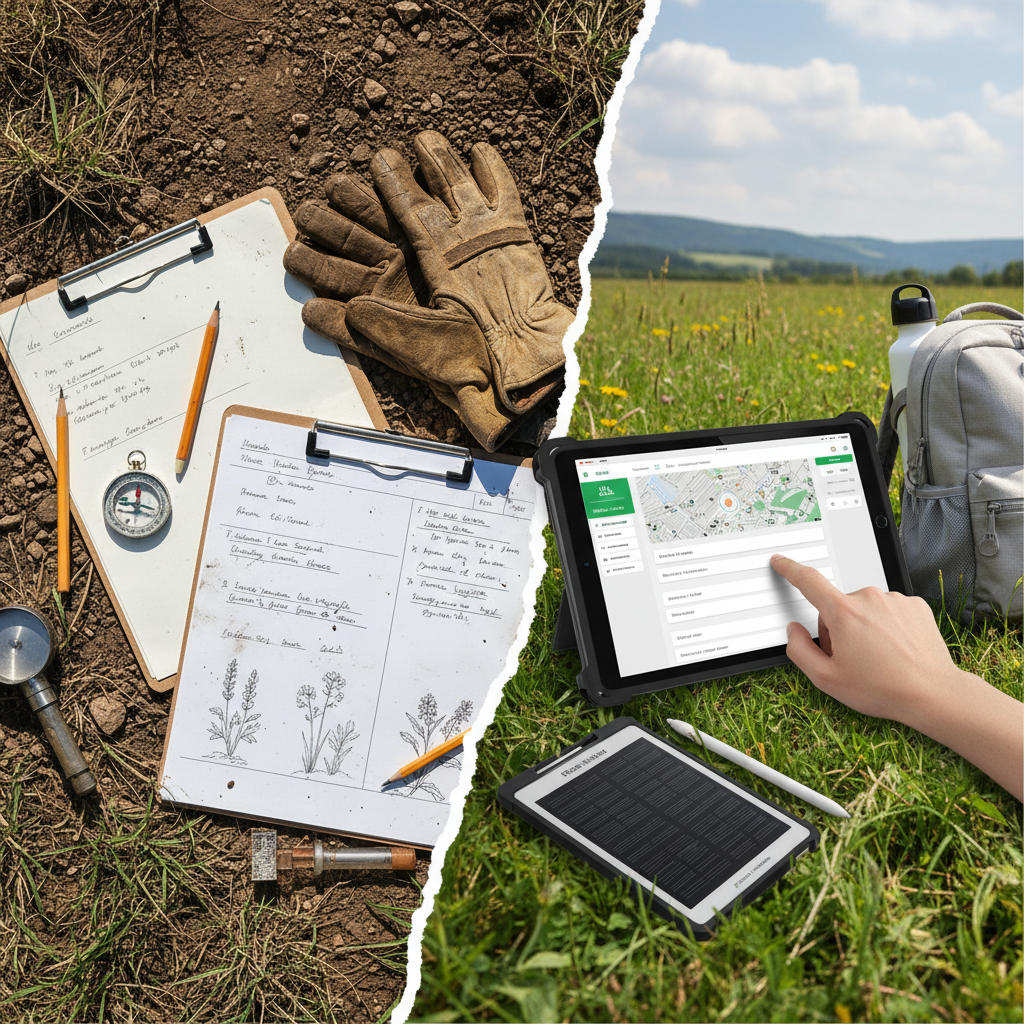
Paper forms feel cheap. A ream of paper costs $5. A clipboard costs $3. But the true cost of paper-based field data collection has nothing to do with the price of paper.
It's the hours your team spends transcribing handwritten notes. It's the project that gets delayed because a field book got wet. It's the inconsistent data that requires manual cleanup before it's usable.
Let's put real numbers on it.
The Hidden Costs of Paper
1. Transcription Time
This is the biggest hidden cost and the easiest to quantify. After a day in the field, someone has to type up handwritten notes, transfer GPS coordinates, and organize photos.
For a typical environmental consulting firm running wetland delineations:
- Average time per data point: 15-20 minutes to transcribe
- Data points per day: 8-12
- Transcription time per field day: 2-3 hours
At a billing rate of $65/hour, that's $130-$195 per field day spent on transcription alone. Over a 100-day field season, that's $13,000-$19,500 — just to type up what was already written down once.
2. Data Entry Errors
Studies on manual data entry consistently show error rates between 1-4%. In field data collection, error rates are higher because of:
- Illegible handwriting (especially in rain or cold)
- Abbreviated notes that lose meaning weeks later
- Transposed GPS coordinates
- Mismatched photo numbers and descriptions
A single data error in an environmental site assessment can mean a return trip to the field — typically $500-$2,000 including travel, per diem, and staff time.
3. Lost and Damaged Records
Paper doesn't survive fieldwork well. Over the course of a year, most firms lose or damage:
- 2-5% of field notebooks (water, mud, misplacement)
- 5-10% of individual form pages (wind, tearing, smudging)
- 15-20% of photo logs (incomplete, mismatched, or illegible)
The cost of re-collecting lost data — or worse, delivering a project with gaps — ranges from inconvenient to project-ending.
4. Photo Management Overhead
Paper photo logs are the weakest link in field documentation. The process:
- Take photo with camera or phone
- Write photo number, description, direction, and coordinates on paper log
- Back at the office, match photos to log entries
- Rename files, add to report, verify GPS coordinates
This process takes 5-10 minutes per photo. A project with 200 field photos means 16-33 hours of photo management — work that digital tools handle automatically.
5. Quality Control and Consistency
When every crew member fills out forms differently, quality control becomes a project in itself. QC reviewers spend hours:
- Standardizing terminology (is it "sandy loam" or "loamy sand"?)
- Filling in fields that crews left blank
- Cross-referencing field notes with GPS data
- Formatting data for client deliverables
The ROI of Going Digital
Digital field data collection eliminates most of these costs on day one:
| Cost Category | Paper (Annual) | Digital (Annual) | Savings |
|---|---|---|---|
| Transcription | $15,000 | $0 | $15,000 |
| Data errors (rework) | $4,000 | $500 | $3,500 |
| Lost records | $2,000 | $0 | $2,000 |
| Photo management | $5,000 | $500 | $4,500 |
| QC overhead | $3,000 | $500 | $2,500 |
| Total | $29,000 | $1,500 | $27,500 |
These are conservative estimates for a small firm (5-person field crew, 100-day field season). Larger firms see proportionally larger savings.
Against these savings, digital field data software typically costs $29-$50 per user per month — a fraction of the paper costs it replaces.
But What About the Learning Curve?
The most common objection to going digital is the transition period. It's a valid concern, but the data doesn't support staying on paper:
- Most field crews are comfortable with digital forms within 2-3 days
- First-season firms typically see 50% of the time savings immediately
- By the second season, the savings compound as workflows are refined
The firms that struggle are the ones that try to digitize everything at once. A better approach: start with one form type on one project, get comfortable, then expand.
Making the Switch
The best time to digitize your field data collection was five years ago. The second best time is before your next field season.
FieldTap is purpose-built for field data collection, with 60+ industry templates, offline capability, GPS-tagged photos, and exports in the formats your clients expect. Start your free trial and see the difference in your first week.