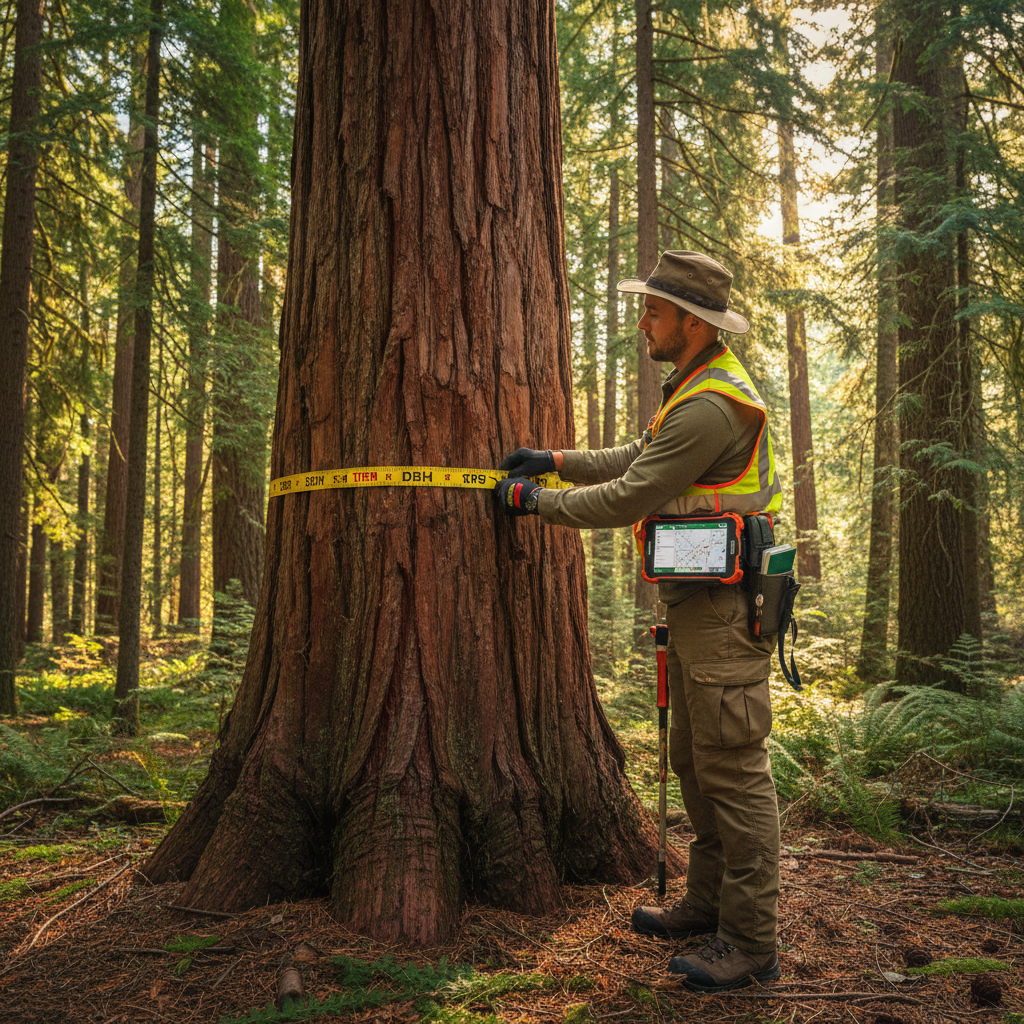
Timber cruising hasn't changed much in decades. A forester walks plots, measures trees, and records data on tally sheets. Back at the truck, they transcribe the tally into a spreadsheet. Back at the office, they run volume calculations and generate the cruise report.
It works. It has worked for fifty years. But working and working well are different things.
The Paper Tally Problem
Paper tally sheets are simple and reliable — until they're not. Every forester has a story:
- The tally sheet that blew off the clipboard into a creek
- The pencil marks that smudged beyond recognition in the rain
- The DBH measurement that got recorded on the wrong line
- The three hours spent in the office deciphering shorthand from a contractor's tally
These aren't rare events. They're Tuesday. And they cost time and money that adds up across a cruise season.
What Digital Timber Cruising Looks Like
A digital timber cruise replaces the paper tally with a field data app on a phone or tablet. Here's what changes:
In the Field
- GPS marks each plot automatically. No more hand-recording coordinates or post-processing GPS tracks.
- Species selection from a searchable list. No abbreviation confusion — is "WO" white oak or water oak?
- DBH entry with validation. The app flags outliers (a 96" DBH might be a misread) before you leave the plot.
- Height, grade, and defect in structured fields. Dropdown menus replace scribbled codes.
- Photos tied to plots. Photograph stand conditions, defect, or access issues — linked directly to the plot record.
At the Truck
Nothing. There's no transcription step. The data is already digital.
At the Office
- Instant export to cruise compilation software. CSV, Excel, or direct integration.
- Volume calculations can begin the same day. No waiting for data entry.
- QC is faster. Digital data is legible, consistent, and filterable. Flag plots with unusual values in seconds, not hours.
The Numbers
Here's how the time breaks down for a typical variable-radius (prism) cruise with 100 plots:
| Task | Paper | Digital | Savings |
|---|---|---|---|
| Plot data collection | 10-15 min/plot | 8-12 min/plot | 20% faster |
| Transcription to spreadsheet | 5-8 min/plot | 0 | 100% eliminated |
| GPS post-processing | 2-3 hours total | 0 (automatic) | 100% eliminated |
| QC review | 4-6 hours | 1-2 hours | ~65% faster |
| Total for 100-plot cruise | ~35 hours | ~20 hours | ~15 hours saved |
At typical billing rates, that's $750-$1,500 saved per cruise. Across a season of 10-20 cruises, the math is compelling.
Common Objections (and Answers)
"My phone won't survive the woods"
Modern phones in ruggedized cases (Otterbox, Catalyst) handle forest conditions better than paper handles rain. And unlike paper, if you drop your phone in a creek, the data is backed up.
"I can't use a touchscreen with gloves"
Capacitive-compatible gloves exist, and most cruising apps support large buttons designed for gloved operation. Some foresters use a stylus. In practice, this is a non-issue after the first day.
"There's no cell service in the field"
Correct — and irrelevant. A properly designed offline-first app works identically without cell service. GPS uses satellite signals, not cell towers. Data syncs when you're back in range.
"I'm faster with paper"
You might be faster recording data on paper. But you're not faster at recording + transcribing + QC + GPS post-processing. Digital is slower at the plot by maybe 1-2 minutes. It's faster at everything else by hours.
"What if the battery dies?"
Carry a portable battery pack. A $25 power bank provides 2-3 full charges and weighs less than a field notebook. Most phones last a full field day with GPS active if you start fully charged.
What to Look for in a Timber Cruising App
Not every field data app is suited for timber cruising. Requirements:
- Offline-first operation — forests don't have Wi-Fi
- Fast, repetitive data entry — you're recording the same fields for every tree across dozens of plots
- GPS with plot centers — automatic coordinate capture at each plot
- Species lists — regional species with common and scientific names
- Flexible cruise types — variable-radius (prism), fixed-area, 100% tally
- CSV/Excel export — compatible with your cruise compilation software
- Durable under conditions — responsive interface, large tap targets, works in bright sun
Getting Started
FieldTap includes purpose-built timber cruising forms with species lists, DBH/height/grade entry, GPS-tagged plots, and CSV export compatible with standard cruise compilation workflows. Works fully offline.
Start a free trial and take it into the woods. If it doesn't save you time on your first cruise, go back to paper.